Last week I had the please of giving a lightning talk on the representation of land in oil painting at the inaugural Land Talks event. I focused on the central, quite compelling, question of “What can we learn about how land has been perceived from oil paintings?”
However, as is the nature of a lightning talk, I only spoke for a few minutes (slides here)—presenting the interesting challenge of condensing 300 years of art and land policy into quite a short summary.
Naturally, this led to my research notes having a large chunk of what I would describe as interesting context removed, and as such inspired this decision to write this post, in which I’d like to walk you through four paintings that track the depiction of land; from a shared subsistence resource, to a broadly unobtainable signal of class divide, and the history that took place in between.
🖼️ Brushstrokes of Power: Land, Art, and the Language of Status
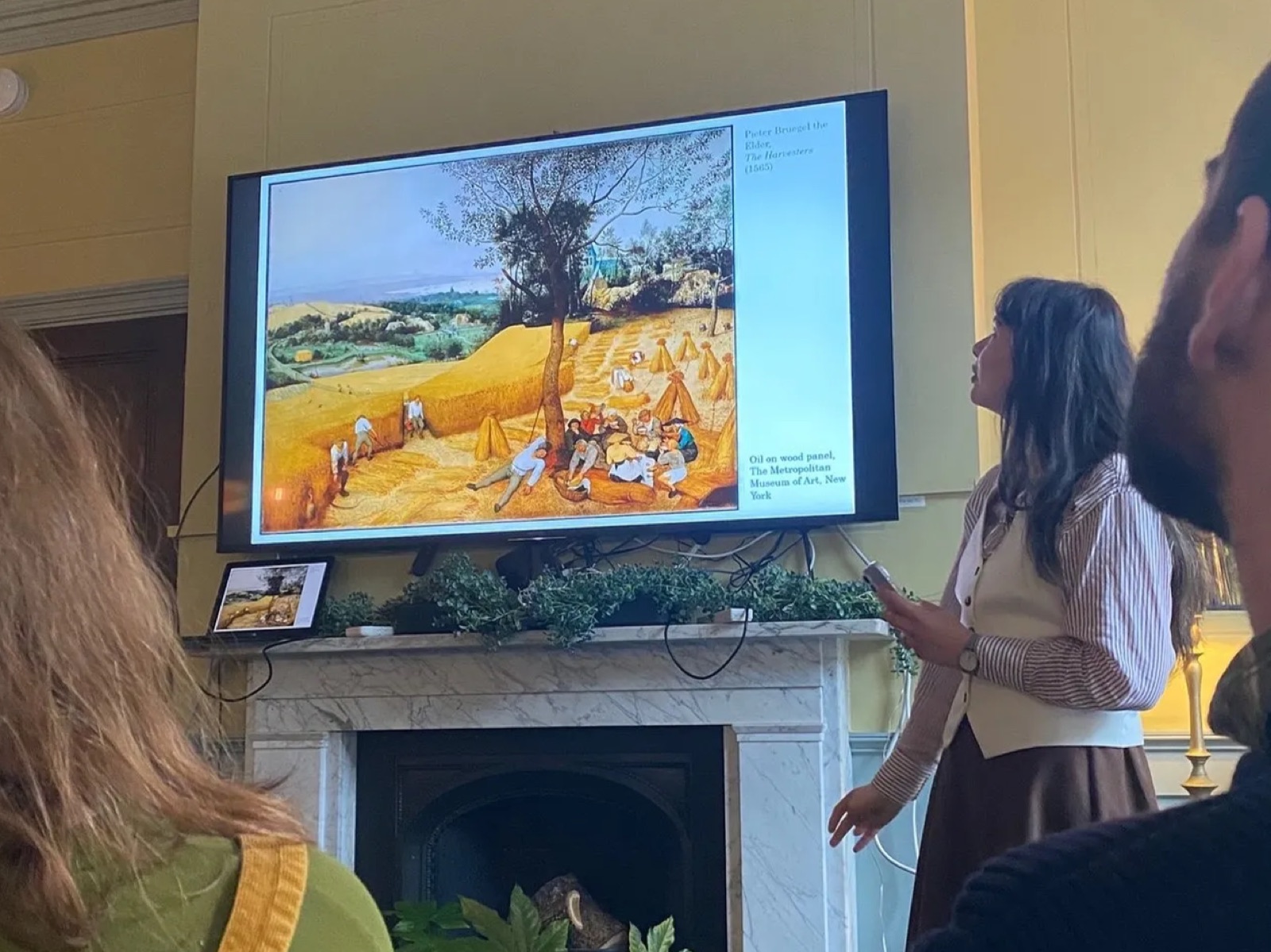
The question of what we can learn about land from oil paintings is particularly interesting one, practically so because the rise of oil paintings coincided with the commodification of land, or maybe because this rise was the direct result of the shift from feudalism to capitalism.
The Feudal Landscape: Land as Collective and Hierarchal
Oil paint was first used in the 15th century, however arguably became an art form in the 16th, and commonly is traditional oil painting set approximately between the 16th and 20th century (Jones, 2002). The shift from feudalism to capitalism began to take hold during the Late Middle Ages (14th–16th century) (Sanders, 1960), formally ended by the Tenures Abolition Act 1660, and shifted to agrarian capitalism over the 18th and 19th centuries (Wrigley, 2010).
The significant overlap in shifting perspectives of land allows us to quite effectively look at the change in its representation in art through the single medium of oil painting. However, there is not a significant amount of oil work to depict feudal life (for reasons outlined in my post Ways of Seeing: Part 3), so in order to paint the contextual scene, if you will, we must discuss feudal life in England through a Dutch Renaissance painter’s work in Flanders.
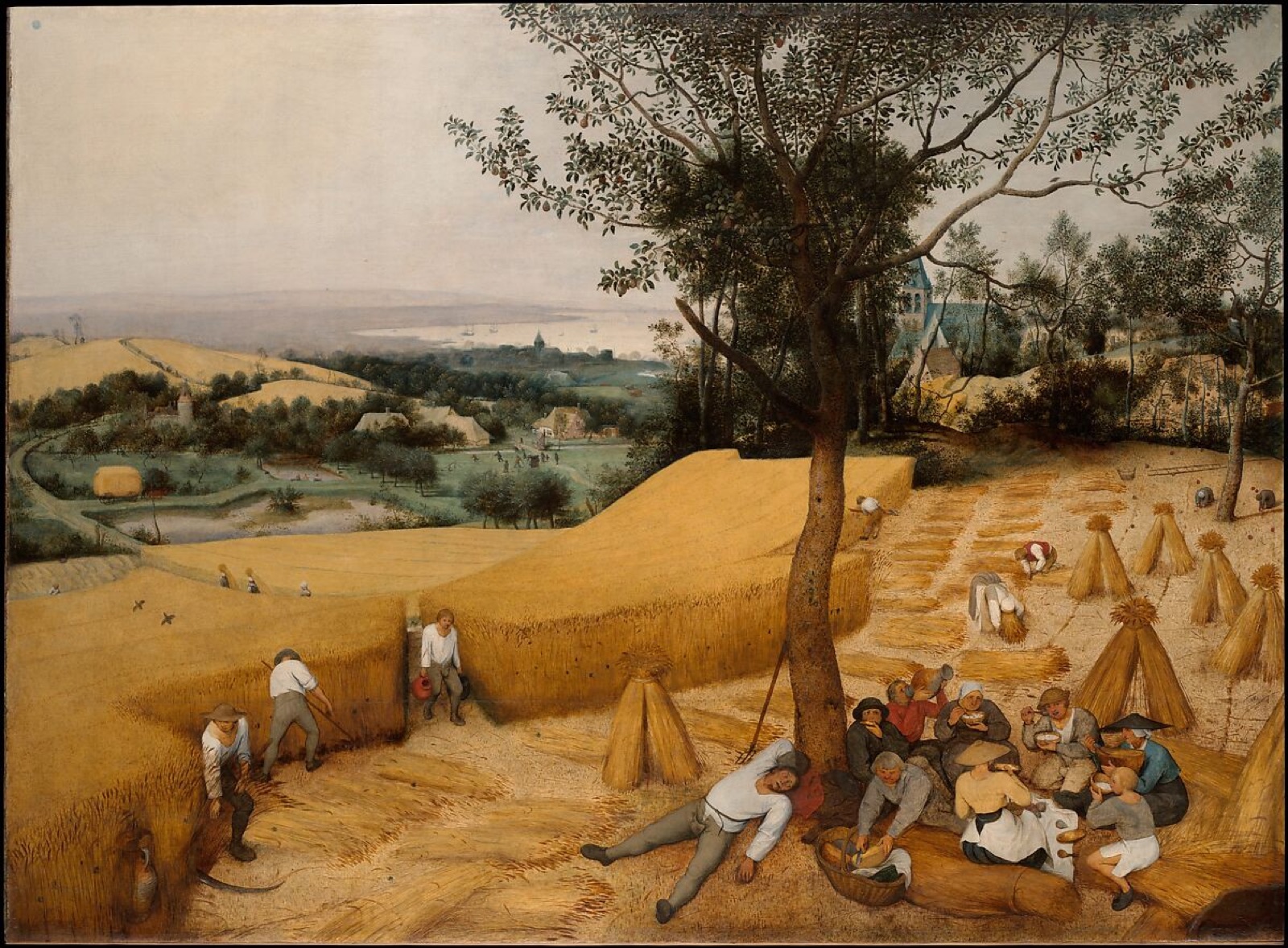
Pieter Bruegel the Elder, The Harvesters (1565)
Oil on wood panel, The Metropolitan Museum of Art, New York
Painted in the late 16th century and during the time when feudalism in England was declining, The Harvesters, is arguably an odd choice to represent feudal life. However, the decline of feudalism occurred more quickly in England, in part due to the Enclosure movement which began in the 12th century (discussed later!), and Bruegel’s depiction here does highlight some important feudal context.
Though Bruegel painted in the Southern Netherlands (modern-day Belgium), the feudal order he depicts was widespread across Europe. Systems of lordship, communal farming, and hereditary hierarchy varied in detail between regions, but their structural features were highly consistent. In both Flanders and England, peasants held customary rights to common land, agricultural labour was seasonal, and status was inherited rather than acquired. Bruegel’s painting, then, is not just a Flemish image—it’s an effective representation of a continent-wide agrarian reality.
This reality was such that in feudal Europe, land was held by titled lords and worked by peasants bound to the manner. Social status was derived from lineage and titles (e.g. Lord of the Manor) **rather than individual material wealth, and the money economy was only important in commercial centres such as London (Kiralfy, Glendon, & Lewis, 2025). Peasants relied on communal farmland for subsistence, land they did not own, that was divided into enclosed strips only controlled by the individuals during the growing and harvesting seasons, and then returned to the disposal of the community. Importantly this land was not owned by the individuals that cultivated it, and to enclose it would be to own or fence it off, preventing common grazing over the land, which did not take place at a large scale until the mid 15th century (The Editors of Encyclopaedia Britannica, 2013).
Bruegel’s work depicts a group of peasants harvesting wheat, labouring together to sustain an estate. Here he presents the land as a collective site of production, where the value on the land arises from communal labour. The absence of any enclosed plots here highlights the peasantry’s role within a broader feudal order—the land here is a shared, hierarchical resource, serving the manors needs. In contrast to later paintings where land would serve to display states, here it serves as a site of survival for the peasants.
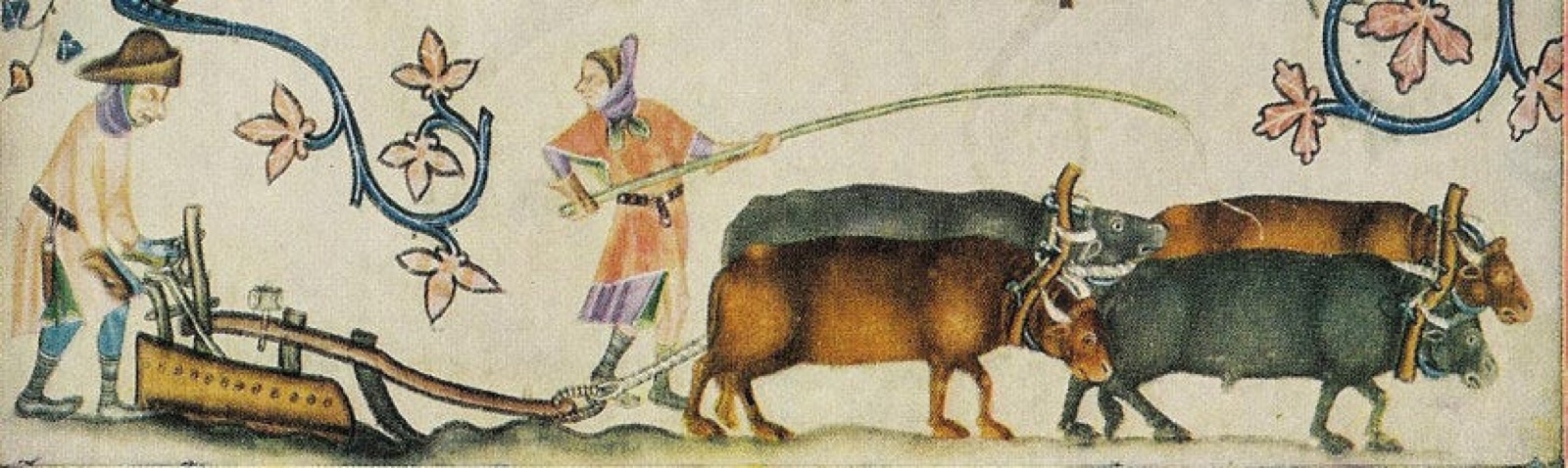
Anonymous, Scene from the Luttrell Psalter, c. 1325–1340
Illuminated manuscript on parchment, British Library, London
The Rise of Private Property: Land as Symbols of Individual Status
While The Harvesters was painted in Flanders, its depiction of rural life resonates with what we know of English agrarian structures during the same period. The Luttrell Psalter (c. 1325–1340), an English manuscript, presents a similar scene: peasants working the land, livestock grazing on common fields, and seasonal nature of cultivation. Despite the difference in medium, parchment rather than oil, the Luttrel Psalter captures the same collective, hierarchical relationship to land.
The Harvesters and Luttrell Psalter reflect a time where land was held in common and worked collectively, however, this agrarian order would give way to a new form of capitalism. Over the next 200 years from the mid 16th century of The Harvesters, England saw a reorganisation of its rural landscape—a transformation driven by the Enclosure movement, the consolidation of communal land into privately owned, enclosed, plots (Neeson, 1993). Beginning in the medieval period but accelerating through the 17th and 18th centuries, enclosure marked a shift in both the use of land and in how it was perceived.
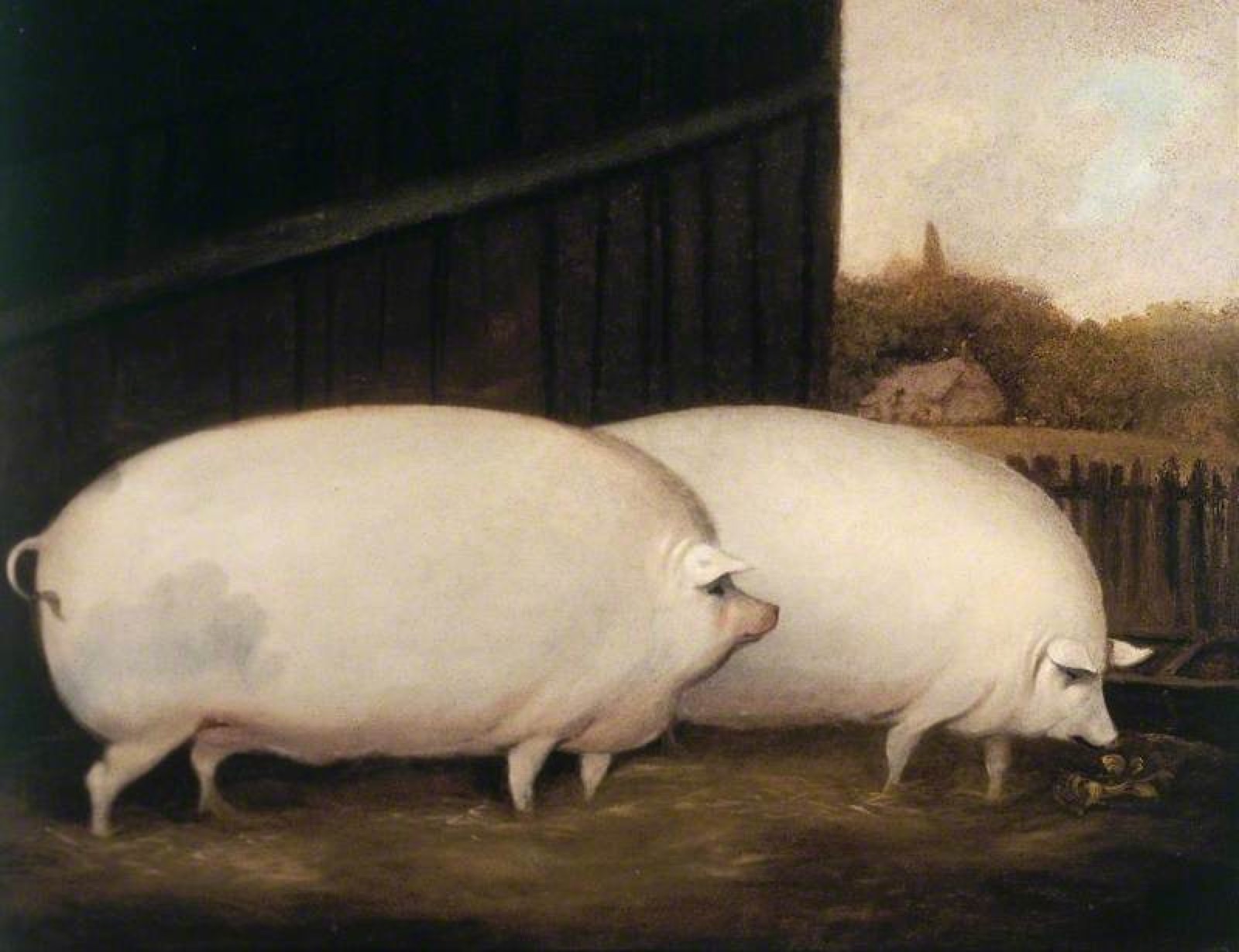
Unknown Artist, A Pair of Pigs (c. 1850)
Oil on canvas, Compton Verney Art Gallery and Park, Warwickshire
This transformation whilst both legal and economic, also reflected a cultural change. As land became privatised, so too did the symbols associated with it. Animals once raised on common grazing fields, such as pigs and sheep, now became private assets, nurtured within enclosed fields and sometimes represented in art as emblems of proprietorship (Howkins, 2003). The oil painting A Pair of Pigs (c. 1850): two overinflated pigs, posed like subjects of a portrait. Their cleanliness and separation from any working environment imply not utility but ownership—they are possessed (Williamson, 1995).
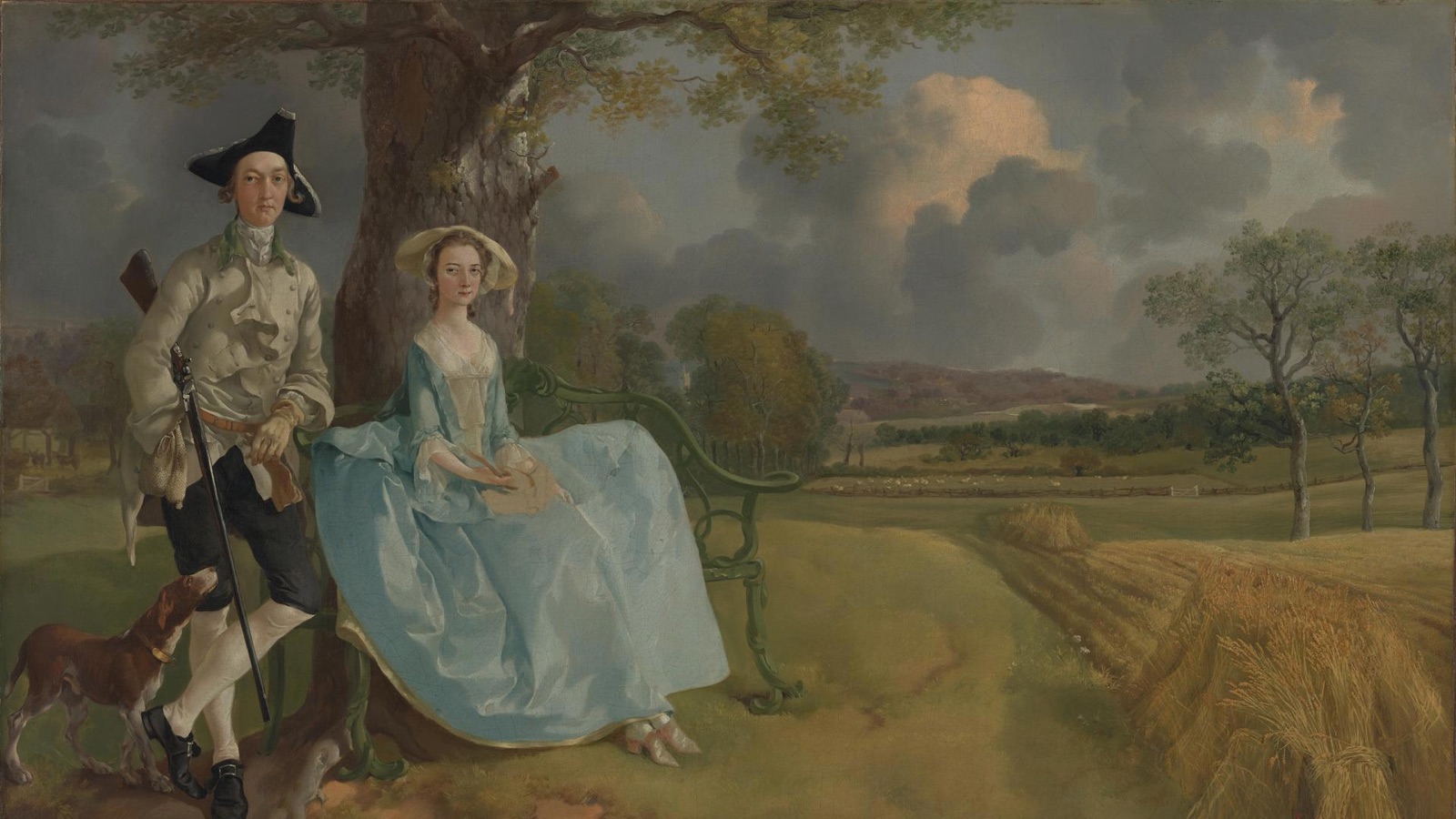
Thomas Gainsborough, Mr and Mrs Andrews (c. 1750)
Oil on canvas, The National Gallery, London
This logic, land and it’s productivity as signs of wealth, finds a more refined expression in Mr and Mrs Andrews (c. 1750) by Thomas Gainsborough. Here, the shift from collective to private is fully visualised. The couple are seated proudly against the backdrop of their estate—not just a backdrop, in fact, but the true subject of the painting. The rolling fields, the tidy rows of crops, and the enclosed parkland all serve to communicate the message that this is their’s, and they own this land. Unlike Bruegel’s anonymous peasants whose labour sustains the land, Gainsborough’s sitters are landowners whose status is sustained by it.
What was once shared and worked-in-common has now become exclusive, bounded, and exhibited.
Idealised Estates: Land as a Projection of Taste
By the early 19th century, the cultural relationship to land had evolved once again. If Gainsborough’s Mr and Mrs Andrews had marked land as a stage for ownership and social display, the next generation of landowners sought to go further—not just owning land, but shaping it to express aesthetic refinement. This time of improvement, the concept that combined Enlightenment ideals of progress with Georgian and Regency tastes for naturalism and civility. To possess land now meant more than inheritance or acquisition for the purpose of wealth generation—but meant stewardship, design, and display.
John Constable’s Wivenhoe Park, Essex (1816) captures this shift. Commissioned by Francis Rebow, the painting depicts the Rebow family estate in a harmonious landscape. Cattle graze peacefully beside a still lake, a modest mansion sits among carefully spaced trees, and the horizon is softened by summer light. The painting is richly detailed, but free of dramatic focal points—everything is ordered, balanced, and benign.
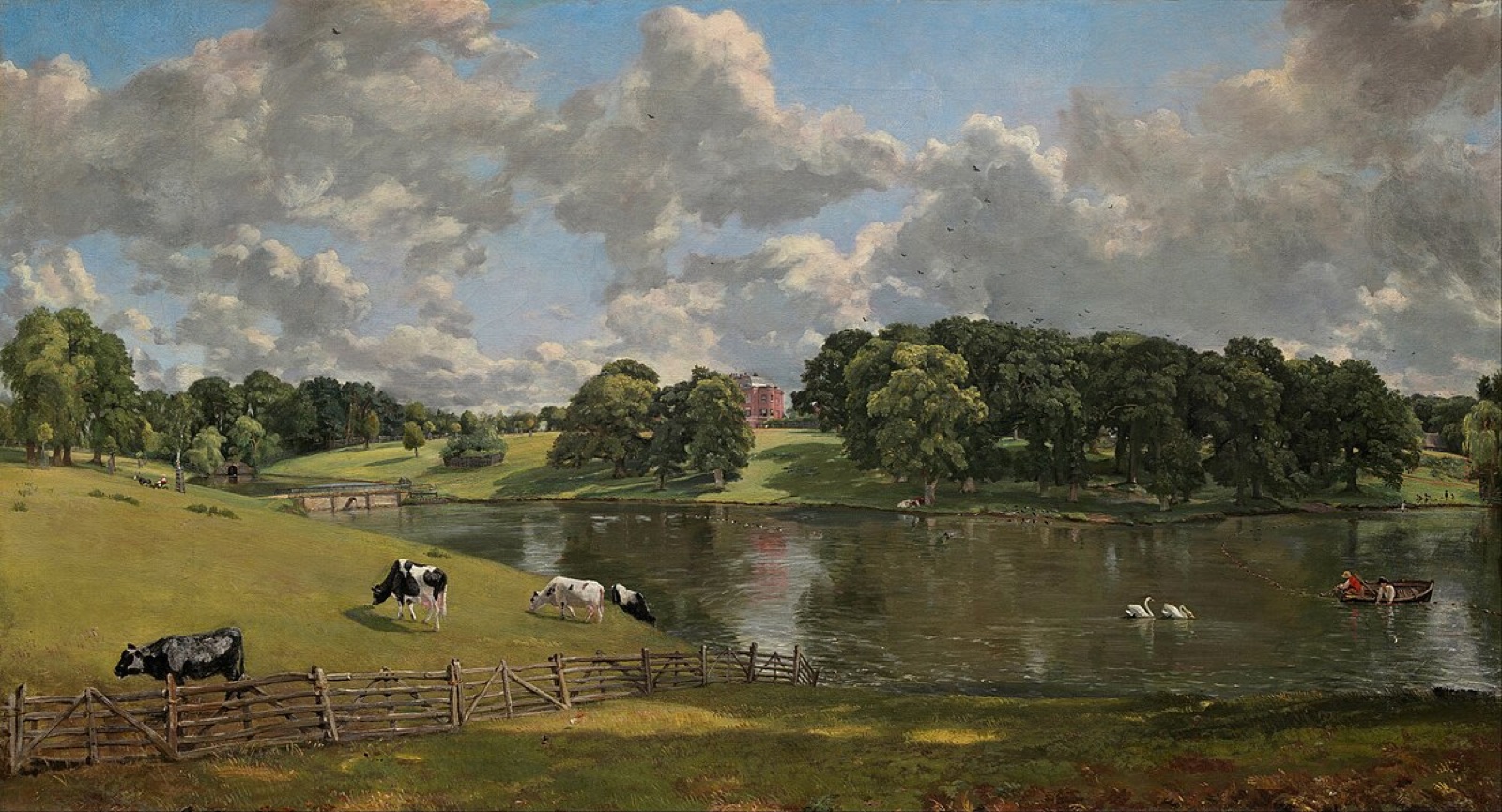
John Constable, Wivenhoe Park, Essex (1816)
Oil on canvas, National Gallery of Art, Washington, D.C.
What’s striking is how little this landscape seems to do. Unlike the bustling labour scenes of Bruegel, or the assertive symbolism of Gainsborough, Constable’s Wivenhoe Park projects serenity. Yet this tranquility is deeply political. The parkland appears natural, but is in fact the product of intense planning and reshaping. The fields are smooth and enclosed, the water is managed, and the grazing animals serve not as economic necessities but as picturesque ornamentation. It is a vision of nature tamed and curated—a pastoral fantastical reality of land not only owned, but controlled.
This aestheticisation of land ownership reflects broader cultural shifts. The rise of landscape gardening, championed by figures like Capability Brown and Humphry Repton, had transformed English country estates into showcases of cultivated nature (Daniels, 1999). To improve land was to align it with ideals of taste, morality, and order—a private Eden reflecting the character and refinement of its owner.
Wivenhoe Park signalled a new chapter in the visual language of land—one in which authority is exercised through beauty, and beauty is inseparable from ownership. If Mr and Mrs Andrews showed us land as a symbol of status, Constable shows us land as a projection of virtue.
Contemporary Perspectives: Land Beyond Private Ownership
By the mid-19th century, the consequences of enclosure and industrialisation were no longer abstract, but quite visible. The English countryside had been reordered into private estates and productive farmlands, while cities grew with a new industrial working class, many of whom had been dispossessed of the land their ancestors once worked on. Against this backdrop, the artistic imagination began to shift. The idealised estate and tranquil land changed to reflect the new urban scene, and the aesthetics of landownership were replaced with the stark realities of labour.
Few paintings confront this shift more directly than Pre-Raphaelite Ford Madox Brown’s Work (1852–65). Where Constable had given us stillness and pastoral calm, Brown gives us movement, chaos, and tension. At its centre are a group of labourers digging up a road in suburban London. They are muscular, sunlit, and central, almost idealised. But unlike the aristocrats of Gainsborough or the gentry of Constable, they are not landowners. They are workers, shaping the land but alienated from its possession.
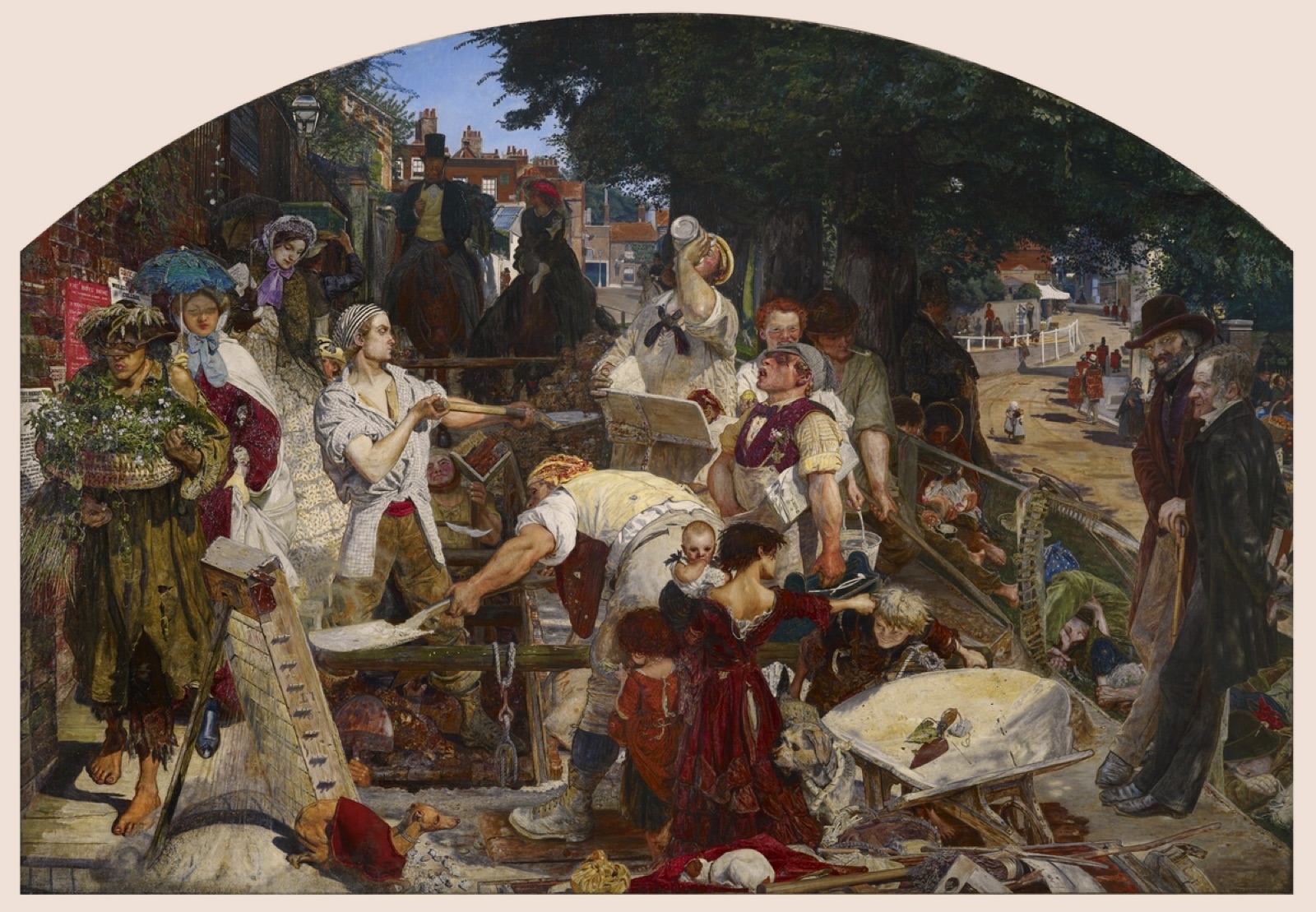
Ford Madox Brown, Work (c. 1852-65)
Oil on canvas, Manchester Art Gallery
Around them cluster representatives of a fragmented society. To the left, educated middle-class reformers distribute pamphlets. To the right, a group of ragged children and a woman with a baby stand passively, figures of poverty. In the background, flâneur aristocrats stroll with no apparent purpose. Nature is present—trees, flowers, sun—but subdued. The real subject here is human struggle, not the land.
In this dense and highly composed scene, Brown performs a radical inversion of the landscape tradition. Land is no longer a site of beauty or a symbol of virtue—it is the stage for structural inequality. The working classes labour on the land. Ownership, once so proudly displayed in Mr and Mrs Andrews, is now entirely absent. In its place is the machinery of capitalism: land that yields profit not pleasure (Rosenblum, 1975).
Brown’s painting is not just a social document, but a challenge. It exposes how the pastoral image of land as tranquil and noble masked the violent history of dispossession that enabled it. It asks what kind of beauty is possible when the land has been taken from the many for the comfort of the few.
Across these centuries, we can trace in oil painting a transformation in the meaning of land itself. From Bruegel’s commons to Gainsborough’s proud estate, from Constable’s curated park to Brown’s fractured London street, land shifts from a shared resource to a symbol of exclusion. The aesthetics evolve, but the underlying question remains: who owns the land, and what does that ownership mean?
Crucially, these paintings do more than depict landscapes—they encode ideologies. They reflect not just what land looked like, but how it was valued, governed, and contested. And just as they offer insight into the past, they leave us with questions for the present: In an age of housing crises, and land speculation, how will land be represented in the next wave of cultural production? Will it be a site of individual subsistence, or of further enclosure?
Kiralfy, A.R., Glendon, M.A., Lewis, A.D. (2025, March 28). common law. Encyclopedia Britannica.
The Editors of Encyclopaedia Britannica (2013, February 25). enclosure. Encyclopedia Britannica.
Neeson, J. M. (1993). Commoners: Common Right, Enclosure and Social Change in England, 1700–1820.
Alun Howkins (2003), “The Discovery of Rural England”. Psychology Press.
Daniels, Stephen. Humphry Repton: Landscape Gardening and the Geography of Georgian England (1999).
Williamson, Tom (1995). Polite Landscapes: Gardens and Society in Eighteenth-Century England.
Rosenblum, Robert. Modern Painting and the Northern Romantic Tradition.