Dethroning the Author
I have been trying to develop my framework for where the value of a work of art comes from, and more broadly the value of anything. A painting has a price at auction, and once had a role for the church or patron that commissioned it, and both of those are forms of value. The one I want to measure is specifically the effect a work has on how I view the world.
It’s worth noting that I’ve realised I can apply this framework to most things I am exposed to, but devised it in relation to art, and so is almost entirely framed through an art lens, hence slight clunkiness. I’d like to abstract this description to a more general model but am yet to do that.
Let’s look at two types of value in relation to an individual. There is the value to the artist, which comes out of the act of making and needs no observer. And there is the value to the observer, which is the effect the finished work has on someone looking at it. I’m specifically interested in the second as I’m not a Dutch master.
I think the value of a work, to an observer, can be framed entirely in how much it shifts your worldview. A work like Bosch’s The Garden of Earthly Delights, which altered how I viewed religion at the turn of the sixteenth century, is worth many times one of the thousands of unattributed still lifes of the seventeenth-century open art market. On this I’d claim the value of a work is the size of the worldview-shift it produces in you.
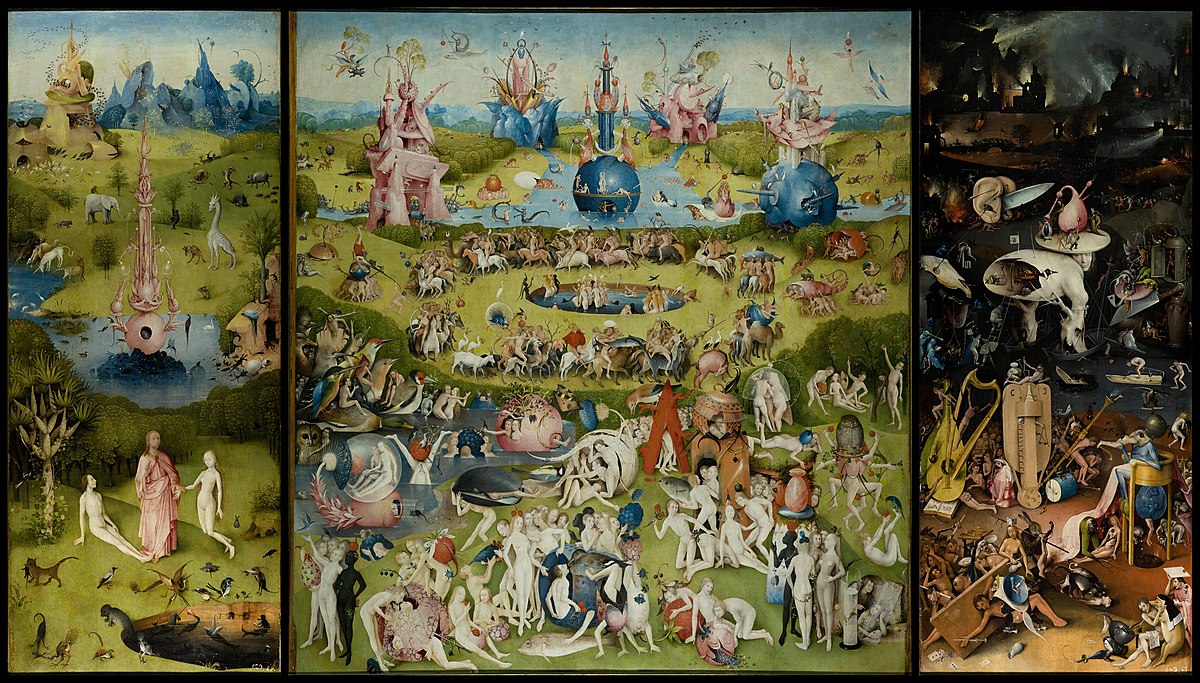
Hieronymus Bosch, The Garden of Earthly Delights (c. 1490–1500).
Two takeaways from this:
- The value shift is unique to the individual. There is no universal quantity of value sitting inside a painting. So to say a work can only ever give you so much, its ceiling, is specific to the individual and not to the work.
- Reaching anywhere near that ceiling needs both the historical context around a work and the lens you bring to it in the present. I tried to put percentages on this, however, the two do not add up meaningfully, and are pretty individual; knowing the history changes what your present eye sees, so they gate each other rather than sitting in distinct buckets. Anyway, worth saying both are needed to get near the ceiling.
Not all worldview-shift is worth the same. For example a religious conversion is about as large a shift as a person can undergo. If size were all that mattered, this would make religious material very valuable. However a convert does not do much cognitive work but is given a pre-prescribed conclusion, and so the worldview shift happened to them instead of being built by them. This, I think, is a distinction that matters;
A worldview-shift loses value to the degree its direction is prescribed to you.
Exposure gives you the basis for an idea, but the impact is in the post processing. So the value comes from the shift you create, and a shift whose direction someone else supplied is discounted in proportion to how much of it they supplied.
This is also, I will admit, where a lot of my instincts about galleries come from, though those instincts sit downstream of this framework. A gallery that is hushed and made to feel like a church is less valuable. A church is an architecture for reception, telling you what to believe, through awe or reverence. The same architecture in a gallery is bad. Reverence discourages the questioning that lets a work reshape you, so the churchlike gallery caps the thing it should exist to offer.
One can claim that the artist would like his intention to dictate what a work means (although I don’t know if this is entirely fair), the art historian, who provides the valuable historical context, would like to say which reading is correct, and for religious art, the church would like to tell you how you ought to adopt what you have seen. Authority over meaning and authority over adoption are the same thing, and the principle that you should be the author of your own worldview-shift is once to uphold, and anyone trying to govern that reception is someone to resist.
In relation to the phrase death of the author, I think you can talk about the dethroning of the author instead. You should not want to remove the artist. If he were truly dead, the fact that somebody made the thing on purpose would count for nothing. What is desirable is to strip him of his authority while keeping his life and intent as a valuable fact to adjust your lens: his life, the circumstances of the work’s making, his stated intention demoted to facts you are free to use or ignore.

If value is just worldview-shift, why does art deserve any special place over a cliff face or a long conversation, both of which can also move you? Art, or the arts, comes packed with the densest human material there is, and that this material is fused to the strongest claims over how it should be read. Nobody makes a claim that a cliff means anything, so what little you do take from it is easily and entirely yours. Art is the opposite, enormously rich and pre-prescribed to verdicts about what it means and how you ought to stand before it. So the entire focus of this framework, the dethroning and divorcing of received readings, is the work of prising the rich material loose from the authority stuck to it, so that I can obtain the most value for myself.
It would be easy to transition into thinking the good thing here is the absence of authority, so that the freest encounter is always the best one. If that were so, the authorless cliff is more valuable and art a distraction. What I want is the maximum of authored shift, and freedom from authority matters only insofar as it serves that. A rich source with its authorities prised off is more valuable than a thin source that never had any. With this in mind art holds the most value by how much authored shift it makes available to whoever is willing to do that work.
The difference between a shift you authored and one that was prescribed to you is a spectrum. A religious convert does do some processing, and I do my questioning with tools and frames I did not invent and mostly absorbed without noticing. I have some confidence that I can feel the difference between working something out and being told it, but I cannot yet defend that difference.